 Gemini 4 Neon
A higher independent score than Opus 5.5 at a lower price, and the clear leader on long documents and business workflows.
 Claude Opus 5.5$4 / $20
 GPT-6.2 Sol$2 / $10Gemini 4 Neon$3 / $15
Google released Gemini 4 Neon on November 18, its fourth new Gemini model in a month. Instead of lining it up against the top models, Google compared it with Claude Opus 5.5 and GPT-6.2 Sol, the two models most people actually use every day. Here's how the three compare on score, price and what a task really costs.
Neon vs Opus 5.5 vs Sol at a glance
| Model | Score | Per million in / out | Cost per task |
|---|---|---|---|
| Gemini 4 Neon | 61 | $3 / $15 | $6.44 |
| Claude Opus 5.5 | 59 | $4 / $20 | $10.04 |
| GPT-6.2 Sol | 57 | $2 / $10 | $1.01 |
Score is the Artificial Analysis Intelligence Index, checked November 18, 2026, with cost per task at each model's top setting. All three have a context window of about 1 million tokens; Sol bills more above 272,000 input tokens. Speeds: Opus 5.5 117, Neon 110 and Sol 85 tokens a second.
Neon scores two points above Opus 5.5 for 25% less per token. Sol is the bargain: a task costs about a dollar, a sixth of Neon's cost, for four fewer points.
What Google's benchmarks show
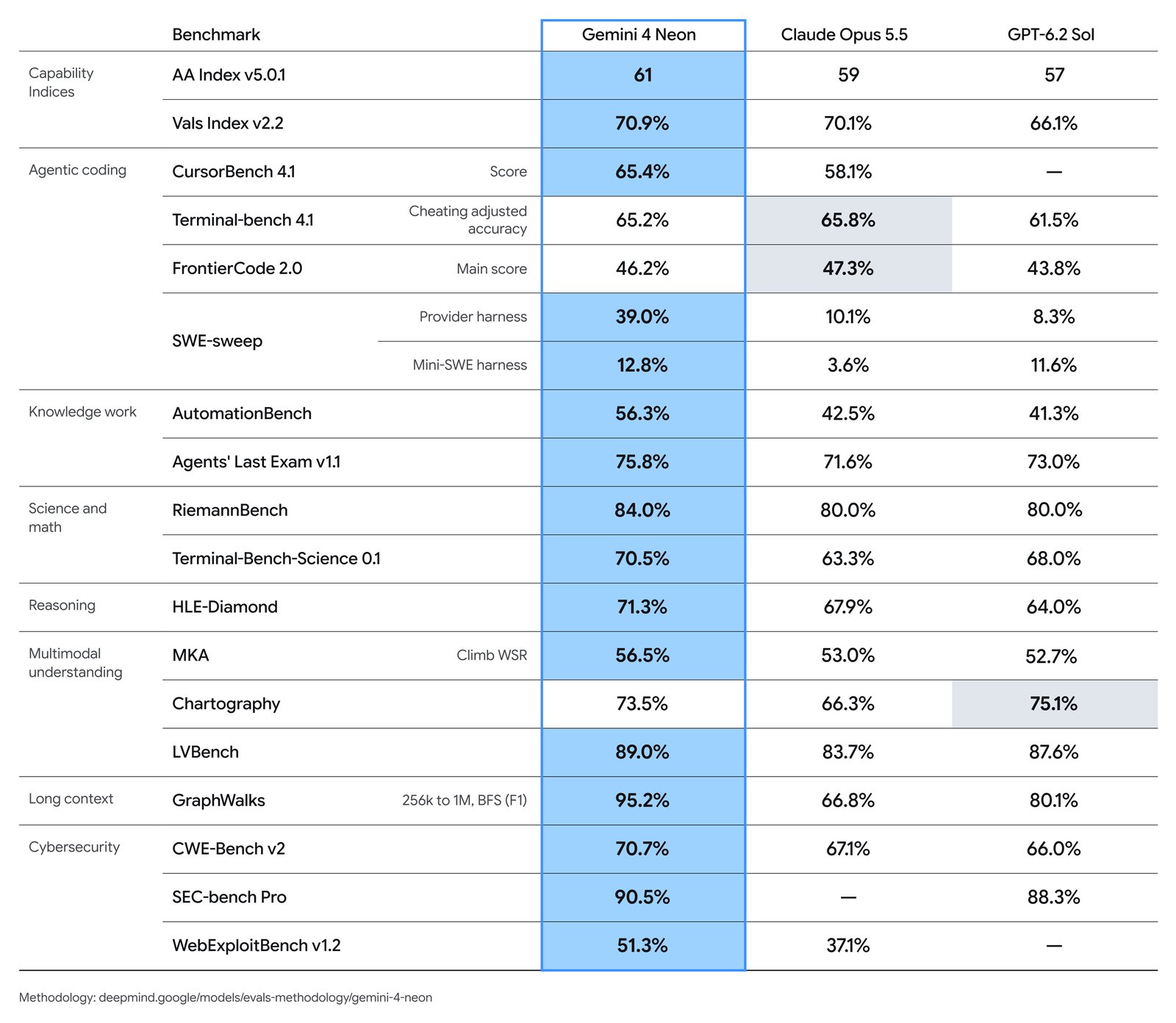
The table at the top is Google's own, so read it as the best case for Neon. It leads 16 of the 19 rows. The rows that matter most:
Neon 95.2%Neon 56.3%Neon 71.3%Neon 65.4%Opus 65.8%Opus 47.3%Sol 75.1%The long-document gap is the biggest: Neon scored 95.2% on GraphWalks, which tests finding answers across 256,000 to 1 million tokens, against 66.8% for Opus 5.5 and 80.1% for Sol. The independent Vals AI index of real-world tasks backs Neon up, at 70.9% to Opus 5.5's 70.1%.
Gemini 4 Neon: more for less, with a catch
Think of it as Google's sharp new hire. Nearly as capable as the seniors and paid less per hour, but it talks a lot, so the bill adds up.

Neon costs $3 per million input tokens and $15 per million output, with cached input at $0.15. It's in the Gemini app on Google AI Pro at $19.99 a month and on Ultra, in the paid Gemini API and in Antigravity, Google's coding app. It isn't on the free API tier.
The catch is length. Artificial Analysis found Neon very wordy at its top setting, so a task costs $6.44 despite the low token price, and its tasks took 21.5 minutes against a 12.4-minute median for similar models. Vals AI found Neon's "high" setting kept 98% of the score at about half the cost, so you rarely need the top setting.
Best for: long documents, spreadsheets and business workflows, especially if you already pay for Google AI Pro.
Skip if: you need quick answers. Use the "high" setting, not the top one, to cut both cost and wait.
Claude Opus 5.5: still the coder's pick
Think of it as the experienced colleague who handles most of the daily work and rarely needs supervising.
Opus 5.5 lost the score race to Neon by two points, but it still won both of Google's own terminal and real-codebase coding tests, and it's the fastest of the three at 117 tokens a second. It's included in the $20 Claude Pro plan with Claude Code.
In our hands-on tests of the top models, Opus 5.5 got every everyday task right and made the most practical plan, though it once added a muddled note nobody asked for.
Best for: coding and writing, and anyone who wants one $20 plan that does both.
Skip if: you mostly work with very long documents. Neon is far better past 256,000 tokens.
GPT-6.2 Sol: the budget pick
Think of it as Astra's little cousin. Works just as hard for a quarter of the pay, with a bit less experience and smarts.
Sol trails Neon by four points but costs about $1 a task, the cheapest strong model you can buy. It beat Neon at reading charts in Google's own table and runs ChatGPT Plus at $20 a month.
Sol shares a launch with GPT-6.2 Astra, whose early reviews have been rough on long jobs. In our short everyday tests Sol was fine, with one silent rounding choice on a money question.
Best for: high-volume chat, support bots, extraction and anything where cost matters most.
Skip if: you need the best reasoning. Neon and Opus 5.5 both score higher.
Which one should you pick?
Want the full picture, including Claude Fable 5.2 and GPT-6.2 Astra? Our best AI model guide has a picker, the top eight models ranked and a cost calculator.
The verdict
Gemini 4 Neon is the best value of the three: a higher independent score than Claude Opus 5.5 at 25% less per token, and far ahead on long documents. Opus 5.5 is still the better coder and lives in the $20 Claude Pro plan, and GPT-6.2 Sol does most everyday work for about a dollar a task.
FAQ
How much does Gemini 4 Neon cost?
$3 per million input tokens and $15 per million output tokens on the Gemini API, with cached input at $0.15. Batch and Flex cost half that. In the Gemini app it comes with Google AI Pro at $19.99 a month and Google AI Ultra.
Is Gemini 4 Neon better than Claude Opus 5.5?
On paper, yes. Neon scores 61 to Opus 5.5's 59 on the Artificial Analysis Intelligence Index, costs less per token and per task, and leads Google's long-document and business-workflow tests. Opus 5.5 still wins two coding tests in Google's own table and is faster.
Is Gemini 4 Neon free?
No. It isn't on the free Gemini API tier, and in the Gemini app it needs a Google AI Pro or Ultra subscription. Free Gemini users get Google's smaller models.
Is GPT-6.2 Sol good enough?
For most everyday work, yes. Sol scores 57, four points behind Neon, but a task costs about $1 against $6.44 for Neon. It's the best choice for high-volume chat, support and extraction.