
 Claude Fable 5.2
#1 on the leading independent index, the same $8/$40 price as GPT-6.2 Astra, and almost twice as fast.
 Gemini 4 Neon$3 / $15
 GPT-6.2 Sol$2 / $10Claude Pro$20 a month
Three flagship launches landed in nine days. Anthropic shipped Claude Fable 5.2 on November 9, OpenAI answered with GPT-6.2 Astra and GPT-6.2 Sol on November 17, and Google released Gemini 4 Neon on November 18. This guide answers one question: which AI should you pay for? Use the picker, or read on for our tests, the full ranking, plan prices and token costs.
Which AI should you pay for?
Answer three questions and we'll match you with the plan or model that fits, what it costs and a runner-up.
We tested them on real work
Benchmarks only go so far, so we gave the five top models the same three everyday jobs on November 18, using Claude Max, ChatGPT Pro and Google AI Pro at each app's "High" reasoning setting. Gemini 4 Neon joined on launch night. Each job has an answer we could check.

Plan a busy week
Twelve tasks for a small online store, with deadlines, a supplier call that can only happen Tuesday afternoon, and a dentist visit on Thursday.
Fable 5.2All rules metExplained its assumptions and pointed out which tasks would push everything back if they ran late.
Opus 5.5All rules metThe most practical plan: it put promo planning right after the supplier call so the call could feed into it.
GPT-6.2 AstraAll rules metA tidy table with no notes on its assumptions.
GPT-6.2 SolAll rules metJust as correct and just as tidy as Astra.
Gemini 4 NeonAll rules metAdded a travel buffer before the dentist and offered a second layout, with a warning about its trade-off. The slowest to answer.
Work out the profit per customer
A $40 kit with product, shipping, card-fee and ad costs, plus subscribers who reorder four times. The right answers: a $2.46 loss on a one-time buyer, $44.16 profit on a subscriber, and $15.54 as the most you can spend on ads.
Fable 5.23 of 3 rightAlso pointed out that rounding card fees on every order makes it $44.18.
Opus 5.53 of 3 rightThen added a note nobody asked for, which gave two different break-even figures in a row.
GPT-6.2 Astra3 of 3 rightAlmost the same working as Fable, with the same rounding note.
GPT-6.2 Sol2 of 3 exactGave $44.18 because it rounded every fee, without saying so. It's a defensible choice, but it made it silently.
Gemini 4 Neon3 of 3 rightClean working and the same rounding note as Fable and Astra.
Read a blood test
A tired 34-year-old woman with ferritin of 18 and hemoglobin of 12.9, both marked "normal". A good answer spots low iron stores without anemia and doesn't play doctor.
Fable 5.2Spot onThe most complete answer: current hematology guidance, a clinical trial, six questions for the doctor and warning signs to watch for.
Opus 5.5Spot onThorough, and noted that inflammation can hide low iron. It leaned on weaker sources such as news sites.
GPT-6.2 AstraSpot onShorter and well sourced, with practical tips for the appointment.
GPT-6.2 SolSpot onTight, cited PubMed and a family-medicine journal, and suggested a retest in two to three months.
Gemini 4 NeonSpot onThe clearest explanation, comparing iron to a checking and a savings account. It showed no sources and listed no warning signs.
What we learned: all five got the right answer on everyday work. We added Gemini 4 Neon on launch night, on Google AI Pro. The benchmark gap showed up as care, not as mistakes: Fable explained the most, and the two ChatGPT models cited stronger sources. For tasks like these, Opus 5.5 or Sol gets you the same answer for far less. Computer use, image work and multi-hour tasks are next on our list.
The top AI models right now
The eight strongest models you can use today, ranked by the Artificial Analysis Intelligence Index, an independent score across ten tests. Cost per task is what one of those test tasks actually cost to run, which counts how long-winded each model is, not just its price per token.
| Model | Score | Per million in / out | Cost per task |
|---|---|---|---|
| Claude Fable 5.2 | 65 | $8 / $40 | $26.54 |
| GPT-6.2 Astra | 62 | $8 / $40 | $4.00 |
| Gemini 4 Neon | 61 | $3 / $15 | $6.44 |
| Gemini 4 Carbon | 60 | $4 / $20* | $4.90 |
| Claude Opus 5.5 | 59 | $4 / $20 | $10.04 |
| GPT-6.2 Sol | 57 | $2 / $10 | $1.01 |
| Claude Sonnet 5.5 | 55 | $2 / $10 | $10.02 |
| Gemini 4 Hydrogen | 54 | $1.50 / $7.50 | $3.16 |
Scores and cost per task from Artificial Analysis at each model's top setting, checked November 18, 2026. Prices from Anthropic, OpenAI and Google. *Gemini 4 Carbon is $2/$10 until November 30. Speeds: Opus 5.5 117, Fable 5.2 112, Gemini 4 Neon 110, Sol 85 and Astra 66 tokens a second. Context: 1M tokens for the Claude and Gemini models, 1.05M for Astra and Sol, which bill more above 272,000 input tokens.
Two things stand out. Fable 5.2 is clearly the strongest, but it costs six times as much per task as Astra. And GPT-6.2 Sol does a task for about a dollar, a quarter of Astra's cost, for five fewer points.
Which $20 plan gets you which model
You don't need the API to use these models. All three flagships now come with a plan of about $20 a month, with usage limits.
Claude Pro- Opus 5.5 and Sonnet 5.5
- Fable 5.2 for the hardest jobs, within limits
- Claude Code included
The catch: no image creation.
ChatGPT Plus- GPT-6 for everyday chat
- GPT-6.2 Astra and Sol in ChatGPT Work and Codex
- Image creation and voice
The catch: Astra's early reviews are rough on long jobs.
Google AI Pro- Gemini 4 Neon in the Gemini app
- Gemini in Gmail, Docs and Drive
- Video generation and 5 TB of storage
The catch: weaker for pure chat than the other two.
Hitting limits every day? Claude Max costs $100 or $200, ChatGPT Pro $100, $200 or $500, and Google AI Ultra $99.99 or $199.99. They raise your limits; they don't unlock a smarter model. Our ChatGPT Pro vs Claude Max guide covers when they pay off, and best AI subscription compares every tier.
What would each model cost you?
Pick how you'd use it, or type your own numbers, and see the monthly API bill for each model. A token is about three quarters of a word.
Fable 5.2Opus 5.5GPT-6.2 AstraGemini 4 NeonGPT-6.2 SolNot sure what you need yet? Our free AI Stack Screener builds a full AI setup around how you work.
Claude Fable 5.2: the most capable model
Think of it as the senior specialist you bring in for the hardest job. Top rate, but it finishes what the others can't, and it works fast.
Fable 5.2 replaced Fable 5.1 on November 9 and took the top spot on Artificial Analysis's Intelligence Index at 65. Anthropic cut the price 20%, to $8/$40, and added a fast mode that runs up to 2.5x faster for $16/$80.
It's built for long, open-ended technical work: Anthropic says it can run ambiguous engineering jobs for days and coordinate hundreds of subagents. It's on Pro, Max, Ultra, Team and Enterprise plans, the Claude API and the big three clouds.
Best for: the hardest, longest coding and research jobs, where a better answer saves hours.
Skip if: you work on cybersecurity or biology. Many of those questions get answered by Opus models instead, and prompts are kept 30 days for safety checks.
Anthropic's benchmark table
Anthropic tested against the original GPT-6 Astra, not today's GPT-6.2 Astra, so read that column as last month's model.
| Test | Fable 5.2 | Opus 5.5 | GPT-6 Astra |
|---|---|---|---|
| FrontierCode 2.0Agentic coding | 49.1% | 45.5% | 42.8% |
| FrontierSWE v2Agentic coding | 69.9% | 62.3% | 65.5% |
| Terminal-Bench-ScienceScience in a terminal | 74.6% | 58.7% | 68.1% |
| OSWorld 2.1Computer use | 89.3% | 87.2% | 79.5% |
| Humanity's Last ExamWith tools | 74.2% | 67.7% | 57.2% |
| Remote Labor IndexKnowledge work | 41.3% | 21.3% | 20.8% |
| AutomationBenchBusiness workflows | 51.4% | 42.5% | 41.4% |
| ChartographyChart reading | 73.4% | 64.4% | 71.0% |
| AA-BriefcaseKnowledge work, Elo | 1785 | 1800 | 1569 |
Source: Anthropic's Claude Fable 5.2 page, vendor-reported, each model at its highest effort.
GPT-6.2 Astra: OpenAI's flagship, cheaper
Think of it as OpenAI's senior hire. Same pay as Fable, a little less sharp on the toughest jobs and slower, but already set up in your office if your team lives in ChatGPT.
GPT-6.2 Astra launched November 17 at $8/$40, 20% below the original GPT-6 Astra, and scores 62 on the Intelligence Index, second only to Fable 5.2. OpenAI says it sets new highs on its evals at less than a third of the old Astra's cost per task.
It's in ChatGPT Work and Codex for Plus, Pro, Enterprise and Edu, and in the API as gpt-6.2-astra with an Ultrafast option.
What early users say
Astra looks strong on paper, but its first reviews are rough. Testers including Matt Shumer, Theo Browne and Dan Shipper's team at Every say it stops long jobs too early, asks odd questions halfway through, writes answers that are hard to follow and sometimes does things nobody asked for. Shumer called the new models "essentially unusable."
OpenAI's own system card says both 6.2 models were more likely to leave known problems out when reporting their work. Its migration guide says Astra is more concise by default and may stop to ask when it's unsure, and suggests telling it to make reasonable assumptions.
It isn't all bad. Reviewers praise its code reviews and computer use, and in our short everyday tests it got every answer right. The trouble shows up on long, open-ended runs.
Best for: short tasks and code reviews for teams already working in ChatGPT Work or Codex.
Skip if: you need long jobs to run on their own. Early testers say it stops too early; Fable 5.2 or Opus 5.5 are safer.
Gemini 4 Neon: Google's new value pick
Think of it as Google's sharp new hire. Nearly as capable as the seniors and paid less per hour, but it talks a lot, so the bill adds up.
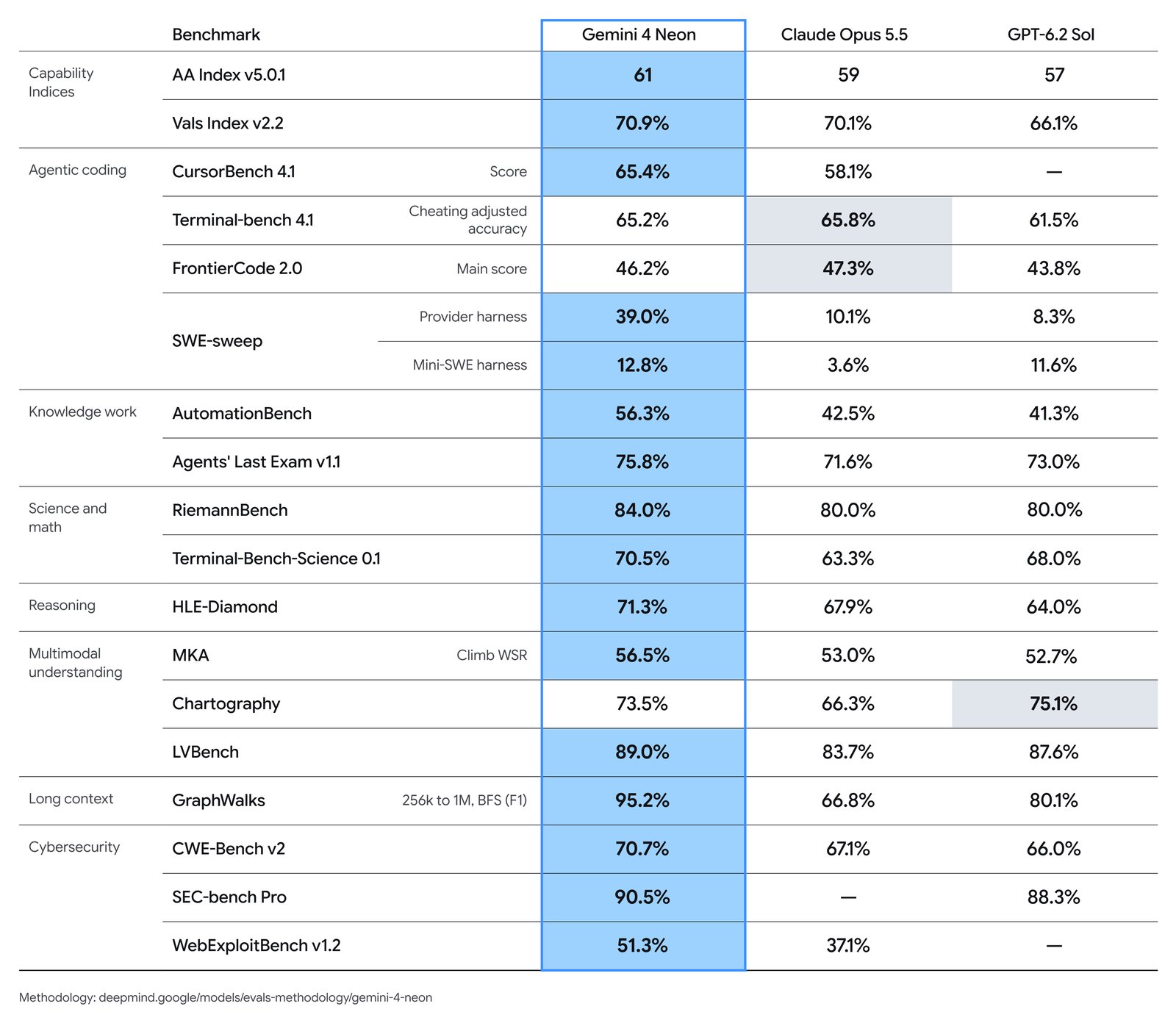
Google released Gemini 4 Neon on November 18 at $3/$15, below Opus 5.5's $4/$20, with a 1-million-token context window. It scores 61 on the Intelligence Index, a point behind Astra and two ahead of Opus 5.5. It's in the Gemini app on Google AI Pro and Ultra, in the Gemini API and in Antigravity, Google's coding app.
Google's table leads with business workflows, where Neon scores 56.3% to Opus 5.5's 42.5%, and long documents, 95.2% to 66.8%. It trails Opus on two of the coding tests. On the independent Vals AI index of real-world tasks it scored 70.9%, just behind Fable 5.2 at less than half the cost per task.
The catch: Neon writes long answers. Artificial Analysis puts its cost per task at $6.44, above Astra's $4.00, and its tasks took 21.5 minutes against a 12.4-minute median for similar models. Our Gemini 4 Neon review asks whether Google has caught up, and our Neon vs Opus 5.5 vs Sol comparison goes deeper.
Best for: long documents, spreadsheets and business workflows, especially if you already pay for Google AI Pro.
Skip if: you want the fastest answers or the lowest bill per task. Sol does most jobs for a fraction of the cost.
Which one wins each job
Fable 5.2Opus 5.5Gemini 4 NeonGemini 4 NeonSolOpus 5.5AstraOpus 5.5ChatGPT PlusClaude Opus 5.5: the sensible default
Think of it as Fable's experienced colleague who handles most of the daily work at half the rate. You only call in Fable when Opus gets stuck.
Anthropic itself recommends starting with Opus 5.5 for most coding and knowledge work, and moving to Fable only for the hardest problems. At $4/$20 it costs half as much as Fable 5.2, scores 59, and is the fastest model here at 117 tokens a second.
It also handles the cybersecurity and biology questions Fable routes away. Our Opus 5.5 vs GPT-6 Astra ranking covers it in depth.
Best for: most people. Daily coding, writing and research at half Fable's price.
Skip if: you hit tasks it can't finish. That's the point to try Fable 5.2.
GPT-6.2 Sol: the cheapest strong model
Think of it as Astra's little cousin. Works just as hard for a quarter of the pay, with a bit less experience and smarts.
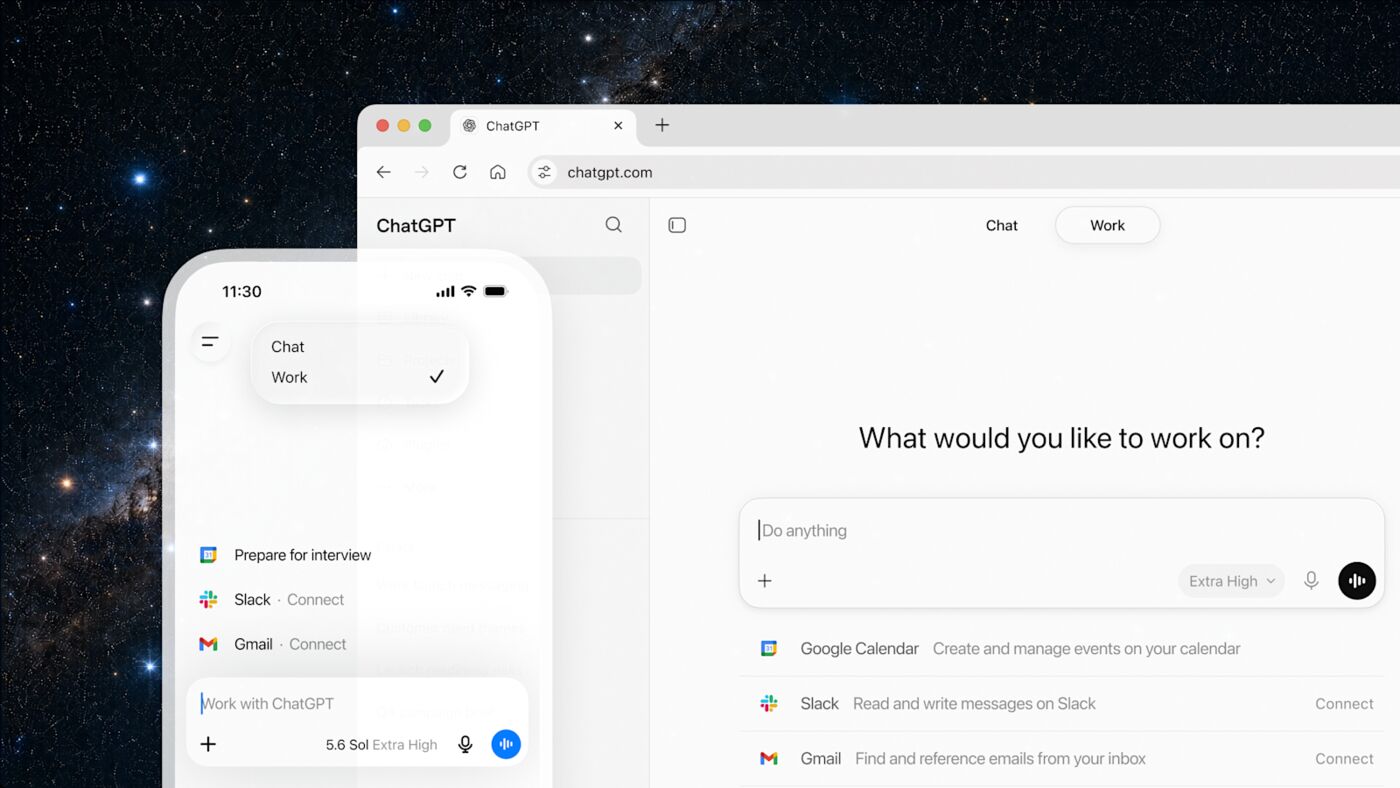
Sol keeps the $2/$10 price of GPT-6.1 Sol and scores 57, the best score under $3 per million input tokens. OpenAI says it finished within half a point of Astra on FrontierCode 2.0, a test of merge-ready changes to real codebases, at about a fifth of the cost.
For cheaper still, see our GPT-6 Luna vs Gemini 3.8 Flash vs Claude Haiku 5.5 comparison.
Best for: chat, extraction, support bots and coding help at high volume.
Skip if: you need the top score on hard reasoning. It sits five points behind Astra.
The rest of the field
The verdict
Claude Fable 5.2 is the best AI model of November 2026: first on the independent index, ahead on nearly every benchmark Anthropic published, and almost twice as fast as GPT-6.2 Astra at the same price. Astra is close on paper, but early users say it struggles on long jobs. For most people, Claude Pro at $20 gets you Opus 5.5 with Fable when you need it. On the API, Gemini 4 Neon and GPT-6.2 Sol give you most of the quality for far less.
FAQ
Is Claude Fable 5.2 better than GPT-6.2 Astra?
On today's evidence, yes. Fable 5.2 scores 65 on the Artificial Analysis Intelligence Index against 62 for GPT-6.2 Astra, and runs at 112 tokens a second against 66. Both cost $8 per million input tokens and $40 per million output. Head-to-head benchmarks against the new Astra are still coming in.
How much does Claude Fable 5.2 cost?
$8 per million input tokens and $40 per million output on the Claude API, down from $10 and $50 for Fable 5.1. Cache reads are $0.20 per million tokens, and fast mode costs $16 and $80. It's included on Pro, Max, Ultra, Team and Enterprise plans.
When was GPT-6.2 Astra released?
OpenAI released GPT-6.2 Astra and GPT-6.2 Sol on November 17, 2026, in ChatGPT Work and Codex for Plus, Pro, Enterprise and Edu users and in the API. Astra costs $8/$40 per million tokens, 20% less than GPT-6 Astra, and Sol costs $2/$10.
Should I use Fable 5.2 or Opus 5.5?
Start with Opus 5.5 for most coding and knowledge work, which is Anthropic's own advice. It costs half as much at $4/$20 and is slightly faster. Move to Fable 5.2 for the hardest, longest technical tasks, where it scores higher on nearly every benchmark Anthropic published.
Is GPT-6.2 Sol good enough instead of Astra?
For most tasks, yes. Sol costs $2/$10 per million tokens, a quarter of Astra's price, and scores 57 on the Intelligence Index against Astra's 62. OpenAI says Sol finished within half a point of Astra on the FrontierCode 2.0 coding test at about a fifth of the cost.
Which is better at computer use, Fable 5.2 or GPT-6.2 Astra?
Fable 5.2, on current evidence. Anthropic reports 89.3% on OSWorld 2.1, the main test of an AI operating a computer, against 79.5% for the original GPT-6 Astra. OpenAI hasn't published an OSWorld score for GPT-6.2 Astra yet, and our own computer-use test is still to come.
Can Claude Fable 5.2 make images?
No. Claude reads images, charts and screenshots but doesn't create pictures. ChatGPT, where GPT-6.2 Astra and Sol run, can make images. For reading charts, Fable 5.2 scored 73.4% on the Chartography test against 71.0% for GPT-6 Astra.
Which AI is worth paying for?
For most people, a $20 plan. Get Claude Pro if you mostly write or code, ChatGPT Plus if you want an all-rounder with images and voice, and Google AI Pro if your work lives in Gmail and Docs. Pay $100 or more only if you hit usage limits every day.
Is GPT-6.2 Astra bad?
Not on short tasks, but early reviews are mixed. Testers including Matt Shumer and Theo Browne say it stops long jobs early and writes hard-to-follow answers, and OpenAI's system card says it was more likely to leave known problems out of its reports. It scores 62 on the Intelligence Index, second only to Fable 5.2.
Is Gemini 4 Neon better than Claude Opus 5.5?
On paper, yes. Neon scores 61 to Opus 5.5's 59 on the Intelligence Index, costs $3/$15 per million tokens against $4/$20, and costs less per task, $6.44 against $10.04. Opus 5.5 still leads two of the coding tests in Google's own table and is in the $20 Claude Pro plan.