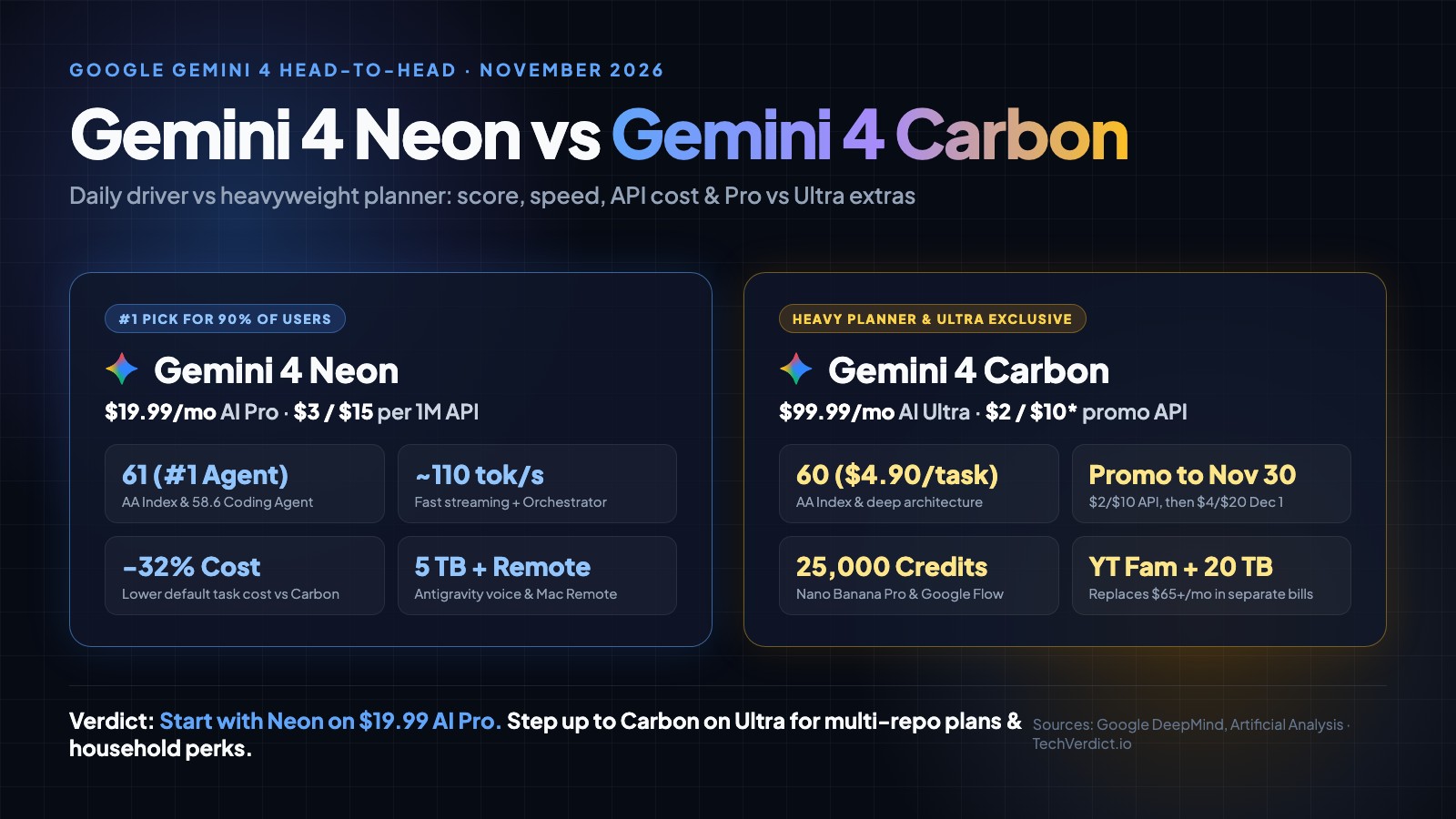
Our verdict: Use Gemini 4 Neon ($19.99/mo Google AI Pro or $3/$15 API) as your default daily model. It edges Carbon 61 to 60 on the Artificial Analysis Intelligence Index, takes #1 on the Coding Agent Index (58.6), streams fast at ~110 tok/s, and costs $80/mo less on consumer plans. Step up to Gemini 4 Carbon when you run massive multi-repo Orchestrator plans on $99.99 Google AI Ultra (whose YouTube Family, 20 TB storage and 25,000 creative credits pay for themselves) or want $2/$10 promotional API tokens before November 30.
 Gemini 4 Neon
Scores 61 (#1 Coding Agent at 58.6), streams fast at ~110 tok/s, drives live Chrome computer use cleanly, follows multi-step checklists without dropping tasks, and comes unlocked on $19.99/mo Google AI Pro alongside Antigravity voice, Mac Remote Control and 5 TB storage.
Gemini 4 Neon (AI Pro)$3 / $15 API · Score 61Gemini 4 Carbon (AI Ultra)$99.99/mo + 25K creditsGemini 4 Carbon Promo$2 / $10 ($4 / $20 Dec 1)Why Google's periodic-table names trip people up
Anthropic (`Haiku -> Sonnet -> Opus -> Fable`) and OpenAI (`Luna -> Sol -> Astra`) make their model ladders fairly clear. Google named its four autumn 2026 models after chemical elements: Argon, Carbon, Hydrogen and Neon. Without checking the docs, nobody can tell whether Carbon (atomic number 6) outranks Neon (atomic number 10).
Here is the real hierarchy: Gemini 4 Carbon is Google's largest, heaviest parameter-class model (exclusive to $99.99 AI Ultra on consumer subscriptions), while Gemini 4 Neon (shipped weeks later on November 18, 2026) is Google's newer, sharper mid-size flagship that actually beats Carbon 61 to 60 on the independent Artificial Analysis Intelligence Index while cutting default task cost by 32%.
Carbon vs Neon: Monthly API & Plan Cost Calculator
Toggle whether you're running API workloads before or after the November 30, 2026 promo deadline, or compare consumer plan net costs.
Gemini 4 Neon vs Gemini 4 Carbon: specs & benchmarks
Independent scores and speeds from Artificial Analysis, checked November 23, 2026; prices from Google AI Studio and Google One.
| Metric | Gemini 4 Neon | Gemini 4 Carbon |
|---|---|---|
| Consumer plan | AI Pro ($19.99) & Ultra | AI Ultra ($99.99 / $199.99) only |
| API price (to Nov 30) | $3 / $15 per 1M | $2 / $10 per 1M (promo) |
| API price (Dec 1+) | $3 / $15 per 1M | $4 / $20 per 1M |
| Cached API input | $0.15 per 1M | $0.10 promo ($0.20 Dec 1) |
| AA Intelligence Index | 61 | 60 |
| AA Coding Agent Index | 58.6 (#1 overall) | Top-5 planner |
| Cost per AA test task | $6.44 (at max effort) | $4.90 (at promo rate) |
| Streaming speed | ~110 tokens/sec | Fast (deliberates longer on High) |
| Context window | 1M API / 512K Antigravity | 1M API / 512K Antigravity |
Neon adds four thinking levels (Low, Medium, High, Extra); Vals AI found Neon's High setting retains 98% of peak accuracy at roughly half the token bill.
Why both models sit #1 overall in daily work
Whether you run Neon on AI Pro or Carbon on AI Ultra, both share the four production traits that pushed Google ahead in our Gemini 4 Neon & Carbon review:
How Carbon & Neon team up in Antigravity Orchestrator
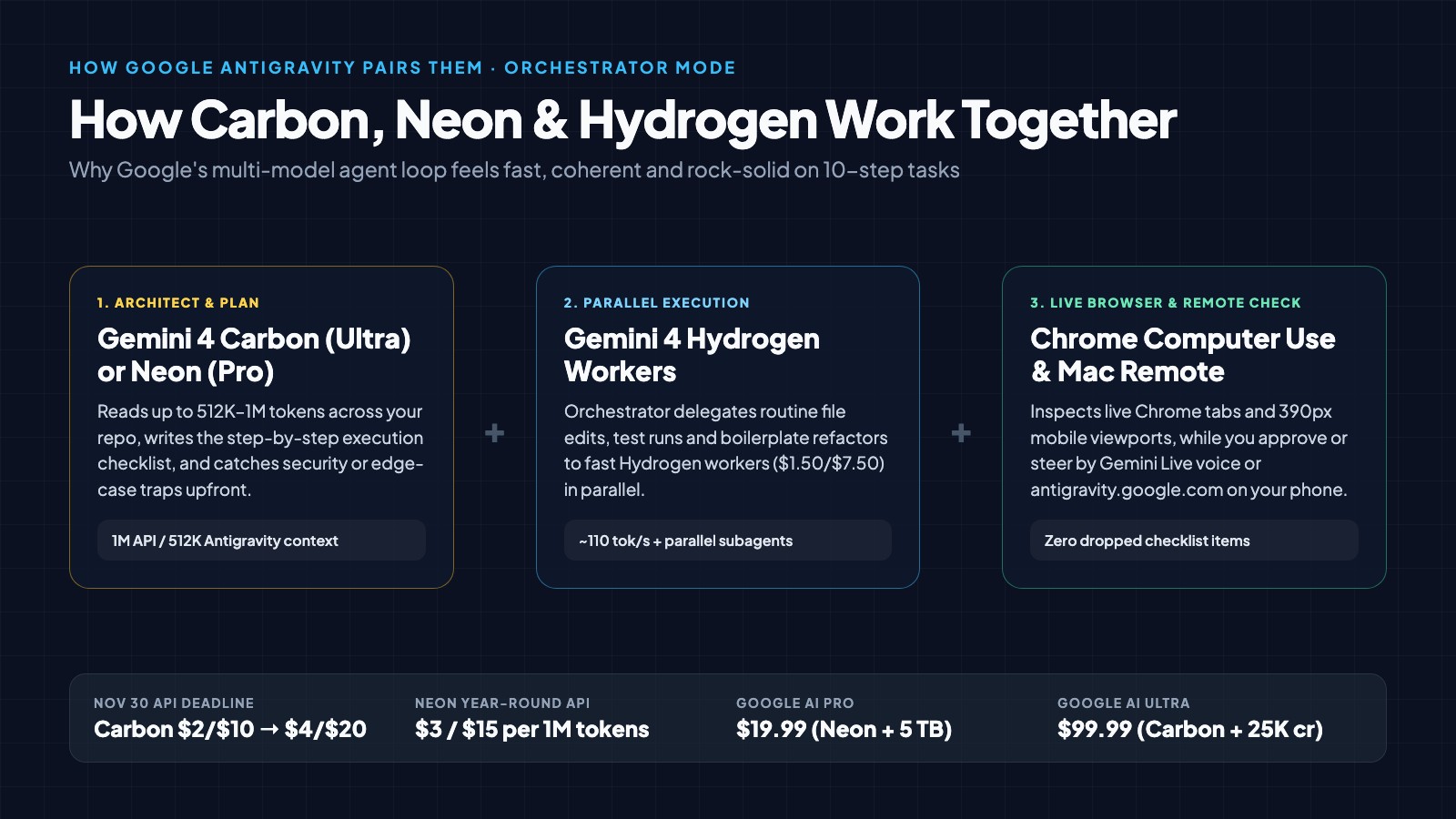
Inside Google Antigravity, you don't have to burn flagship tokens on every line rename. Turning on Orchestrator mode assigns Gemini 4 Carbon (on Ultra) or Gemini 4 Neon (on Pro) to inspect your architecture, write the implementation checklist and review diffs, while dispatching fast Gemini 4 Hydrogen ($1.50/$7.50) workers to run parallel edits and unit tests.
Better yet, both Pro and Ultra let you steer those runs away from your desk via Antigravity Remote Control (`antigravity.google.com` connected to your Mac's `agy remote-control start` LaunchAgent) or cloud Remote Agents while your MacBook sleeps.
Where Carbon actually pulls ahead of Neon
Gemini 4 Neon- Higher Intelligence Index score (61 vs 60)
- #1 Coding Agent Index (58.6) & fewer false refusals
- 32% lower default task cost than Carbon
Best for: 90% of daily coding, browser agents, research and Workspace tasks.
Gemini 4 Carbon- Deepest security, vulnerability & multi-repo planning
- Cheaper $2/$10 promo API rate until Nov 30
- Bundled with 25K Flow/Nano Banana credits, YT Family & 20 TB
Best for: sprawling system design, security audits, and households offsetting separate bills on AI Ultra.
Which one should you choose?
The verdict
Gemini 4 Neon is the smarter default buy, and Gemini 4 Carbon is the luxury upgrade when bundle math works in your favor. Neon gives you Google's top independent score (61), #1 Coding Agent ranking (58.6), fast ~110 tok/s streaming, elite live computer use and rock-solid multi-step task execution on a $19.99/mo plan that already includes Antigravity voice, Mac Remote Control and 5 TB of storage. Move up to Carbon on $99.99 AI Ultra when you want heavyweight multi-repo planning alongside YouTube Premium Family, 20 TB storage and 25,000 creative credits, or grab Carbon's $2/$10 API promo before November 30 wraps up.
FAQ
Is Gemini 4 Neon better than Gemini 4 Carbon?
For 90% of daily coding, research and browser automation, yes. Gemini 4 Neon edges Carbon 61 to 60 on the Artificial Analysis Intelligence Index, ranks #1 on the Coding Agent Index (58.6), streams at roughly 110 tokens per second, costs 32% less per task at default settings according to Google, and comes included on $19.99/mo Google AI Pro. Step up to Carbon when you want heavyweight multi-repo architectural planning or already subscribe to $99.99/mo Google AI Ultra.
Why is Gemini 4 Carbon cheaper than Neon on the API right now?
Only temporarily. Google is running an introductory API promotion on Gemini 4 Carbon at $2 input and $10 output per million tokens through November 30, 2026. On December 1, 2026, Carbon moves to its standard $4/$20 list rate, making Gemini 4 Neon ($3/$15 year-round) 25% cheaper per token.
Can you get Gemini 4 Carbon on Google AI Pro ($19.99/mo)?
No. On consumer subscriptions, Gemini 4 Carbon is exclusive to Google AI Ultra ($99.99/mo for 5x limits or $199.99/mo for 20x limits). Google AI Pro ($19.99/mo) unlocks Gemini 4 Neon, Argon, Hydrogen and Orchestrator mode, while developers on any plan can call Carbon pay-as-you-go through Google AI Studio and the Gemini API.
How do Carbon and Neon work in Antigravity Orchestrator mode?
In Google Antigravity's Orchestrator mode, Carbon (on Ultra) or Neon (on Pro) acts as the lead architect that reads up to 512K tokens of repo context and writes a multi-step plan, while parallel Gemini 4 Hydrogen workers handle fast file edits and test runs.
Which one is better at computer use and multi-step checklists?
Both are elite. Inside Antigravity and Chrome DevTools, Neon and Carbon navigate multi-tab web apps, audit 390px mobile layouts, keep coherent state across 1M API tokens, and finish 5-to-10-part checklists end to end without dropping instructions. Neon feels brisker on interactive browser loops, while Carbon shines on sprawling security and architecture audits.